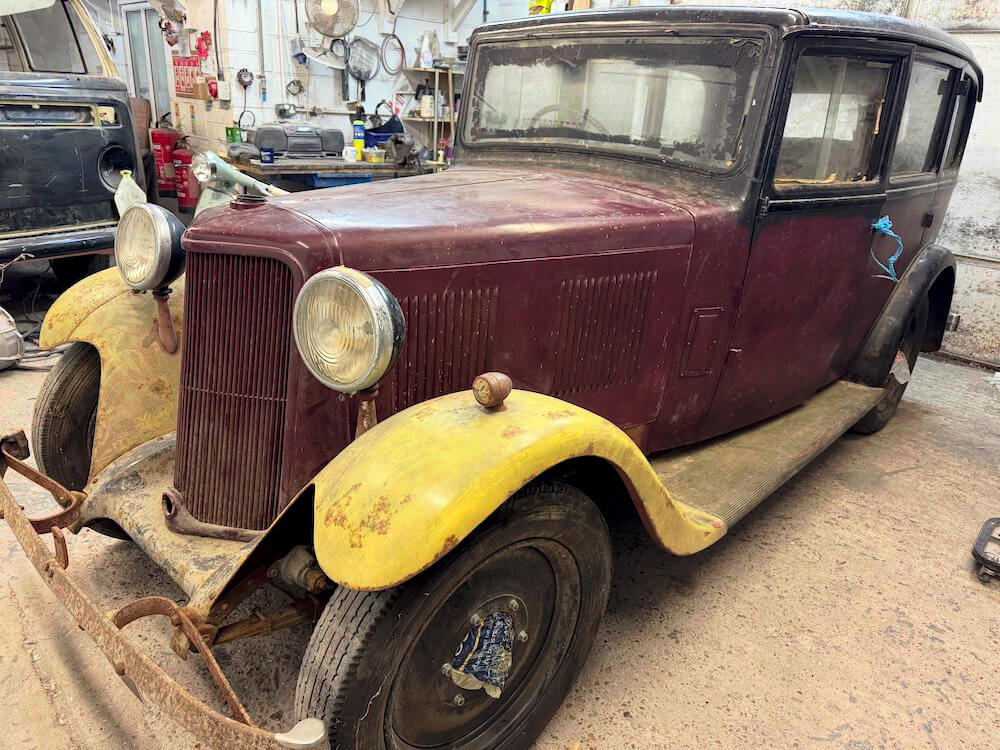
There is a strange question hanging over the future of motoring. If cars are becoming quieter, cleaner, more connected and increasingly capable of driving themselves, where does that leave the classic car?
On paper, the classic looks like the wrong machine for the age we are entering. It burns petrol. It needs regular attention. It has no lane assist, no touchscreen, no battery management system and no software updates. Some classics do not even have seatbelts fitted as standard. A few need warming up carefully, coaxing into gear and listening to with one ear slightly tuned for trouble.
And yet, that is exactly why they matter.
The future of motoring may well be electric, automated and digitally controlled. That does not mean the past becomes irrelevant. If anything, the more modern cars remove the driver from the mechanical experience, the more value there will be in cars that still ask something from us.
Modern cars are changing quickly. Electric vehicles are becoming more common, manufacturers are investing heavily in battery technology, and assisted driving systems are moving from novelty to normal. The language around motoring has changed as well. We talk about range, charging speed, software, sensors and driver aids in a way that would have sounded absurd to most motorists a generation ago.
There are good reasons for this shift. Cities need cleaner air. Manufacturers need to meet environmental targets. Drivers want lower running costs, smoother performance and more convenience. For a daily commute, a modern EV can make complete sense. Quiet, quick, easy to drive and less mechanically demanding in the traditional sense.
Self-drive technology is part of the same direction. The idea is simple enough: reduce human error, make journeys easier, improve traffic flow and give people back time. Whether the reality arrives smoothly is another matter, but the direction is clear. The car is becoming less of a machine you operate and more of a device you manage.
That is a big cultural change.
For many motorists, it will be welcome. Not everyone enjoys driving. Not everyone wants to think about gear changes, engine temperature, choke settings, oil pressure or brake feel. Most people simply want a car to work. Fair enough. For everyday life, reliability and convenience matter.
But that is not the whole story of motoring.
A classic car is not just about getting somewhere. It is about how you get there.
The steering has weight. The brakes need judgement. The engine has a particular note. The gearbox has its own habits. You learn the car rather than simply operate it. Every older vehicle has a personality, and some of that personality comes from imperfection.
We see this all the time at White’s Bodyworks. Owners do not bring in classics because they are the easiest vehicles to live with. They bring them in because the car means something. Sometimes it is a model they always wanted. Sometimes it belonged to a parent or grandparent. Sometimes it is simply a machine they enjoy understanding.
Modern cars are very good at reducing effort. Classics do the opposite. They make the process visible. You feel what is happening through the wheel, pedals, seat and sound. If something changes, you notice. A slightly rough idle, a pull to one side, a gear that does not quite engage as it should. The car communicates, but not through a warning message.
That is part of their value.
As modern cars become smoother and more automated, the old-fashioned act of driving may become more special, not less. A classic car turns a simple journey into an event. Not because it is fast or luxurious, but because it involves you.
The awkward issue, of course, is fuel.
Classic cars were built long before modern emissions standards, and no one should pretend they are as clean at the tailpipe as modern vehicles. They are not. But the environmental argument around classics is more nuanced than it first appears.
Most classic cars cover very low annual mileage. They are not usually being used for a daily motorway commute or sitting in traffic five days a week. Many come out on weekends, for shows, summer runs, club meets or occasional local use. Their environmental footprint needs to be seen in that context.
There is also the question of keeping an existing vehicle alive. Building a new car carries its own environmental cost, from mining materials to manufacturing, shipping and disposal. A classic that is repaired, maintained and used sparingly is part of a different kind of motoring economy. It is about preservation and longevity rather than consumption.
That does not make every old car environmentally harmless. It simply means the issue is not as simple as old equals bad and new equals good.
In practice, the future may involve a mixture of approaches. Daily transport becomes cleaner and more efficient. Older vehicles are used more selectively, cared for properly and kept roadworthy by specialist workshops. That feels more realistic than pretending every car from the past must disappear.
This is the concern many owners quietly have. Will there come a point where petrol cars are pushed out completely? Will classics become museum pieces? Will regulation make them impossible to use?
No one can predict every future rule, but there are good reasons to think classic cars will continue to have a place. Historic vehicles are already treated differently in several areas, because they are recognised as part of motoring heritage. They are not the main source of road emissions, and they are not used in the same way as mass daily transport.
That does not mean owners can be complacent. The classic car world has to make a sensible case for itself. That means responsible use, good maintenance, safe repairs and an honest approach to roadworthiness.
A badly maintained classic belching smoke and wandering across the road does the whole movement no favours. A properly looked-after car, used considerately and kept in sound condition, is a very different thing.
This is where workshops matter. If classic cars are to remain accepted on modern roads, they need to be maintained to a standard that respects both the vehicle and everyone else using the road. Brakes, steering, tyres, lights, structure and suspension all matter. Nostalgia is not a substitute for safety.
One of the biggest threats to classic cars may not be legislation at all. It may be knowledge.
As the motor industry moves towards electric drivetrains and software-led diagnostics, traditional mechanical skills risk becoming less common. Carburettors, distributors, points, drum brakes, manual adjustment, metal fabrication, panel beating and old-fashioned fault finding are not central to modern technician training in the way they once were.
That matters.
Classic cars need people who understand how they were built. Not just people who can plug in a diagnostic tool, but people who can listen, measure, adjust, fabricate and repair. A classic vehicle often tells you what is wrong in physical ways. You need to know what worn metal looks like, how old repairs fail, how rust travels through seams and how a car should feel when it is set up correctly.
At White’s Bodyworks, this is a large part of what makes classic work interesting. It is not only about fixing the fault in front of you. It is about understanding the age, construction and history of the vehicle. Previous repairs often tell a story. Sometimes a car has been patched to pass an MOT years ago. Sometimes a panel has been repaired well, but with materials that have not aged in the same way as the original metal. Sometimes the mechanical issue is not one fault, but five small faults working together.
That type of judgement comes from experience.
If classic cars have a future, then so do the skills needed to repair them. Welding, fabrication, paint preparation, mechanical restoration and careful assessment are not outdated trades. They are becoming more important because fewer people can do them properly.
One of the more interesting developments in the classic car world is electric conversion. Take an older vehicle, remove the combustion engine, fit batteries and an electric drivetrain. Done well, the result can be quick, quiet and usable.
For some cars, this makes sense. If the original engine is missing, damaged beyond reasonable repair or not especially central to the car’s identity, an EV conversion may give the vehicle a new lease of life. It can make a classic easier to use in urban areas, reduce maintenance and appeal to owners who want the look of an old car without the mechanical demands.
But it is not the answer for every classic.
For many vehicles, the engine is part of the soul of the car. A Triumph TR3 without its mechanical rasp, a BSA twin without its pulse, a Volvo P1800 without the feel of its original drivetrain, would become something different. Not necessarily worse, but different.
There is also the question of reversibility and quality. A poorly executed EV conversion can damage a car’s structure, balance and value. Batteries are heavy. Mounting points matter. Brakes and suspension may need rethinking. Wiring and safety systems need serious attention. It is not just a case of swapping one power source for another.
In practice, EV conversion will probably become one branch of the classic world rather than its replacement. Some owners will embrace it. Others will preserve original drivetrains. Both approaches can exist, provided the work is done properly and the car’s character is understood.
There is a lazy assumption that classic cars are only for older owners. That is not quite true. Younger enthusiasts may not always want the same classics, but the interest is still there.
For some, 1980s and 1990s cars are now classics. Hot hatches, Japanese sports cars, early performance saloons and modern classics like the Honda S2000 are becoming increasingly valued. These cars sit between eras. They have enough modern usability to feel familiar, but enough mechanical honesty to feel special.
That matters for the future. The definition of a classic is always moving.
A young enthusiast may not dream of the same car as someone who grew up around Austin A30s or Ford Cortinas. They may want a Peugeot 205 GTI, Mazda MX-5, BMW E30, Subaru Impreza, Toyota MR2 or Honda Civic Type R. Those cars deserve the same kind of thoughtful repair and preservation.
The classic car world survives by widening its view, not narrowing it. Pre-war cars, post-war saloons, British roadsters, old motorcycles, camper vans, Japanese modern classics and 1990s performance cars can all sit within the same culture. What links them is not age alone. It is the desire to preserve vehicles with character.
There is something deeply satisfying about keeping an old vehicle on the road.
Not everything has to be replaced when it ages. Not every worn part means the whole machine is finished. Repair itself has value. There is a quiet pleasure in taking something tired, assessing it properly, repairing what needs attention and returning it to use.
We see that in bodywork restoration, mechanical rebuilds, MOT welding, paint repairs and classic servicing. Sometimes the work is dramatic. A full restoration, an engine rebuild, major fabrication. Sometimes it is modest. A sill repair, brake overhaul, arch fabrication, cooling issue or careful respray.
The scale of the job is not always the point. The point is that the vehicle continues.
That idea feels more relevant now, not less. In a world where so much technology is sealed, replaced and discarded, classic cars remind us that repair is possible. Metal can be cut out and remade. Engines can be stripped and rebuilt. Panels can be reshaped. Paint can be restored. Mechanisms can be understood.
There is a kind of optimism in that.
Is There a Future For Classic Cars?
Yes. But it may be a more thoughtful future.
Classic cars will not compete with EVs on efficiency. They will not compete with self-driving cars on convenience. They will not win the argument if the only question is how to move people from one place to another with the least effort.
But that is not the only question.
Classic cars offer involvement, history, craftsmanship and character. They teach mechanical sympathy. They preserve design and engineering from different periods. They connect generations. They make people care about the machine, not just the journey.
As motoring becomes more automated, that may become more valuable. The classic car’s future is not as everyday transport for everyone. It is as heritage, hobby, craft and experience.
That future depends on owners, clubs, specialists and workshops doing things properly. Keeping cars safe. Repairing rather than bodging. Preserving skills. Being realistic about use, emissions and condition. Treating old vehicles as living machines rather than ornaments.
At White’s Bodyworks, that is the part we understand best. A classic car does not need to be perfect to deserve care. It needs to be assessed honestly, repaired properly and maintained with respect for what it is.
So yes, there is a future for classic cars.
It may sit alongside EVs, automated vehicles and technology we have not even got used to yet. It may be smaller, more specialist and more deliberate. But as long as people still want to feel the road, hear an engine working, understand a machine and keep a piece of motoring history alive, classics will have a place.
And when they need welding, paint, mechanical repair or a patient pair of experienced eyes, that place usually starts in a workshop rather than a software update.