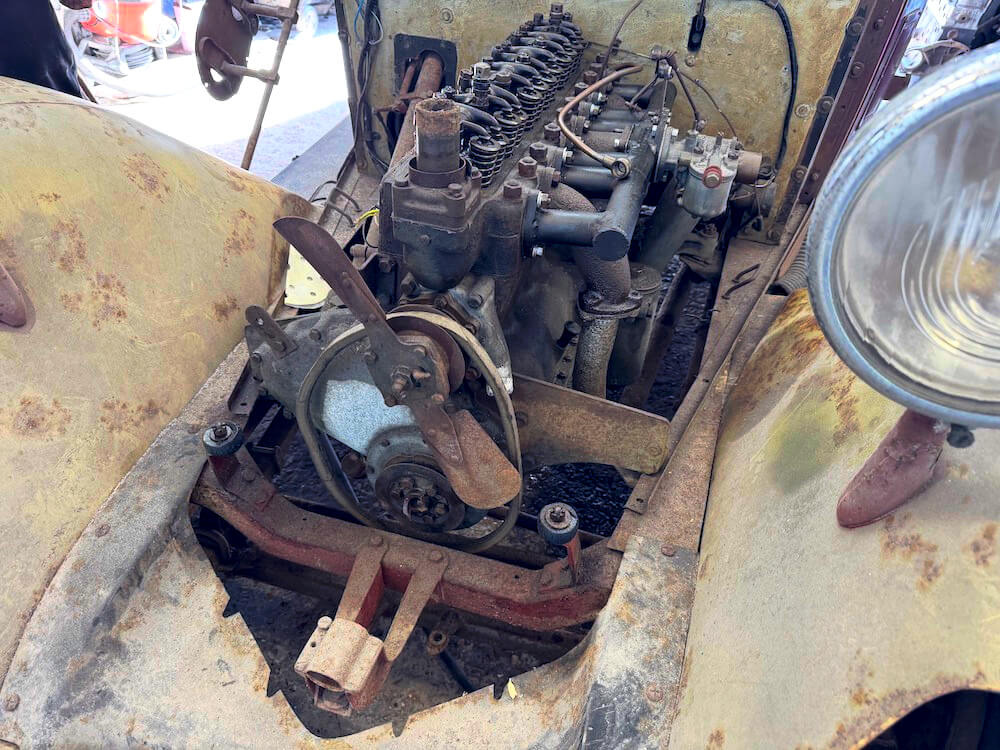
Classic cars are often simpler than modern vehicles, but that does not mean they are easier to repair properly.
In some ways, the opposite is true. Older cars usually give you fewer warning lights, fewer stored fault codes and much less electronic help. What they do give you is noise, smell, feel, vibration and wear patterns. You need to know how to read those clues.
At White's Bodyworks, we often see classic cars that have been loved, polished and carefully stored, but not always maintained in the places that matter most. A car can look beautiful on top and still have tired brakes, weak cooling, poor previous repairs or corrosion hiding where the owner cannot easily see it.
Classic car repair is not about replacing parts until the problem disappears. It is about understanding the car as a whole.
A modern car often fails in fairly predictable ways. Sensors, modules, electronic systems, suspension joints, brakes and service items all have their patterns.
Classic cars are different because their individual history matters much more.
Two cars of the same model and year can be completely different underneath. One may have spent most of its life garaged and well maintained. Another may have been patched through MOTs, left standing for ten years, recommissioned quickly and then sold as a running project.
We regularly see older cars where the current fault is only the latest chapter. A rough-running engine might be caused by ignition, fuelling, compression, old fuel lines, a worn carburettor, poor earths or a combination of several issues.
A brake problem might not simply be worn shoes or pads. Old fluid, sticking cylinders, perished hoses, poor adjustment or contamination from a leaking seal can all contribute.
With classics, the visible symptom rarely tells the whole story.
Most classic cars have been repaired before. Some repairs are excellent. Some are not.
We regularly uncover older work that may have made sense at the time but has not stood the test of time: a sill patched rather than properly cut back, filler hiding an arch repair, wiring altered without suitable connectors or a cooling-system modification that solved one problem but created another.
That does not always mean the previous repairer did a poor job. Sometimes they were working to a budget. Sometimes parts were difficult to find. Sometimes the goal was simply to keep the car usable for another year.
The problem is that an old repair can eventually become part of the new fault.
Before deciding how to repair a classic, it helps to establish what is original, what has been altered and what has already been repaired once before.
This is one of the reasons targeted classic car repair can require more investigation than the same apparent fault on a modern vehicle.
Rust is one of the biggest issues affecting classic vehicles, but it is also easy to misjudge.
Owners naturally worry about the corrosion they can see: a bubbling arch, a scabby lower wing or a blister near a door bottom.
Those areas matter, but structural corrosion can be far more significant.
Sills, inner arches, chassis rails, floor edges, suspension mountings and seat-belt mounting points all deserve careful inspection. On many classics, corrosion progresses from the inside out. By the time it appears on the surface, the metal behind it may already be thin.
We often see cars that look tidy from a few feet away but require proper welding underneath. The opposite can also be true: a cosmetically scruffy car may still be structurally sound.
Rust therefore needs to be judged by its location, depth and effect on the surrounding structure, not simply by appearance.
Where corrosion has become structural, our classic car welding service covers localised repairs, fabricated sections and more extensive restoration metalwork.
A good respray starts long before paint is mixed.
If old repairs, surface corrosion, poor filler work or unstable paint are left underneath, they usually come back eventually.
Classic cars can be particularly awkward because the paintwork may have accumulated in layers over several decades. Original paint, older resprays, local repairs, primer, filler and touch-ups can all exist on the same panel.
Before refinishing, those layers need to be understood.
Good classic paintwork is not simply about achieving shine. The panels need to be sound, repairs need to be stable and the surface needs to be properly prepared before the finish is applied.
For cars needing more extensive refinishing, see our classic car respray service.
There is a common idea that older cars are easy to repair because they are mechanically simple. There is some truth in that, but simple does not mean crude.
A carburettor needs to be set up correctly. Ignition timing matters. Valve clearances matter. Brakes need adjustment. Cooling systems need to be clean and efficient.
Small errors can change how the whole car feels.
A classic that starts reluctantly, idles unevenly and feels flat may not need major work. It may simply need someone to go through the fundamentals properly.
Equally, a car that appears to run well may still have poor compression, weak oil pressure or a cooling problem that only becomes apparent on a longer journey.
Good classic repair is often patient repair.
Routine maintenance and mechanical upkeep are covered separately through our classic car servicing and MOT service.
Classic cars were designed for different roads, different traffic and different expectations.
A 1950s saloon, 1960s sports car or 1970s motorcycle was not designed around today's congestion, sustained dual-carriageway speeds and stop-start traffic.
That does not mean they cannot cope. Many can, provided they are maintained properly.
Cooling systems are a good example. An older car may run happily on open roads but struggle in traffic because of a partially blocked radiator, weak fan, ageing hoses or an unsuitable thermostat.
Brakes are another. A classic braking system in good condition can feel perfectly safe, but poor adjustment or uneven wear can become much more noticeable in modern traffic.
In West Sussex, rural lanes, damp storage, winter salt and occasional long runs all affect vehicles differently. Even a classic used only on sunny weekends benefits from regular inspection and maintenance.
Repair and restoration are often spoken about as though they are the same thing. They are not.
A repair usually addresses a specific problem: a failed sill, brake fault, dented panel or overheating engine.
A restoration is broader. Bodywork, structure, paint, mechanical systems, trim and overall condition begin to overlap.
The important thing is knowing which approach the car actually needs.
Not every classic benefits from a full restoration. Many are better served by careful repairs that preserve more of the original vehicle.
At the same time, if corrosion is widespread, previous repairs are failing and several mechanical systems are tired, repeated local fixes can become uneconomical.
For larger projects, our classic car restoration service covers more extensive multi-stage work.
Classic owners do not all want the same thing.
Some prioritise originality: correct finishes, factory details, period-correct parts and preservation wherever possible.
Others prioritise usability. They want a car that starts reliably, copes with traffic, stops well and can be enjoyed without constant concern.
Neither approach is inherently wrong.
The important thing is making changes deliberately. An improved cooling fan, electronic ignition or discreet braking upgrade might make sense for one owner and not for another.
We tend to be cautious about unnecessary modernisation. Classics have character because they are different. But sympathetic improvements can sometimes make a car considerably easier to use without changing what makes it special.
A proper inspection can prevent money being spent in the wrong order.
We sometimes see cars where new trim has been fitted before structural welding, paintwork has been completed before mechanical problems were resolved, or parts have been replaced without identifying the underlying fault.
A good assessment looks at the vehicle as a whole: structure, corrosion, panel condition, brakes, suspension, steering, engine, electrics and previous repairs.
Not every issue needs to be fixed immediately, but it should be understood.
That allows the work to be prioritised sensibly:
Owners of MOT-exempt or infrequently used vehicles who specifically want a roadworthiness assessment can also book a classic vehicle safety inspection.
Classic cars are not always cheap to repair properly.
Parts can be difficult to source. Labour takes time. Old fixings break. Hidden corrosion appears and previous repairs complicate the job.
The temptation is to choose the quickest or cheapest solution, particularly with bodywork.
Sometimes a limited repair is perfectly appropriate. But where a temporary patch simply conceals a larger problem, putting it right later can mean paying once for the short-term fix and again to undo it.
Good work does not automatically mean a full restoration or unlimited spending. It means choosing a repair appropriate to the condition and intended use of the vehicle.
The best classic cars are not necessarily the most perfect ones. They are the ones that are used, maintained and understood.
Regular use can help. Cars do not always respond well to sitting unused for long periods. Seals can dry out, brakes stick, fuel deteriorates, batteries weaken and tyres age.
Basic maintenance makes a real difference:
From a workshop point of view, the most useful starting point is an honest assessment of what the car actually needs.
Sometimes the news is good. The problem is relatively contained and the repair straightforward.
Sometimes more is uncovered: additional corrosion, failing historic repairs or mechanical wear that needs attention before cosmetic work makes sense.
Either way, knowing the true condition of the vehicle allows better decisions to be made.
Classic cars deserve proper care, but also realistic thinking. They were built as machines, not ornaments. Even rare or valuable cars still rely on the fundamentals: sound structure, reliable mechanical systems, effective brakes, predictable steering and protection from corrosion.
Classic car repair is different because the cars themselves are different. Their age, history and previous work all matter.
A good repair respects what the car is. It does not replace original material unnecessarily, but it does not ignore developing problems either. It balances preservation with safety and originality with usability.
If your classic has a specific fault, damaged bodywork, corrosion or an issue that needs proper investigation, White's Bodyworks provides classic car repairs in Sussex from our workshop near Hassocks.
Send us some details and photographs of the vehicle and we can advise on the most sensible next step.