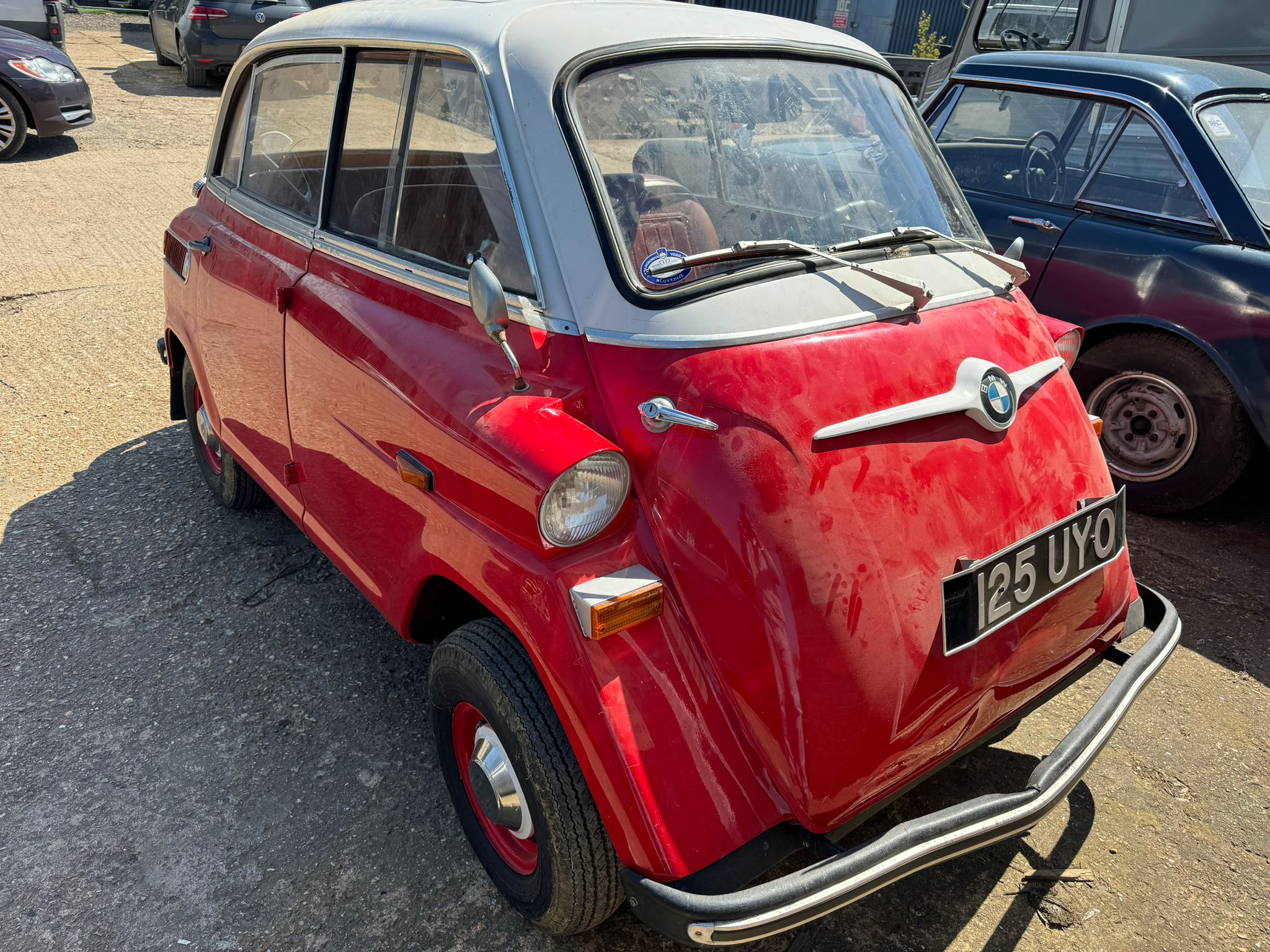
The BMW 600 is not a car most people see every day. Built between 1957 and 1959, it sits in an interesting place in BMW’s history. It bridged the gap between the tiny Isetta bubble car and the later, more conventional saloons that helped stabilise the company. It’s small, narrow and unmistakably of its time, but it also represents a turning point.
The 600 used a motorcycle-derived flat-twin engine mounted at the rear, driving the rear wheels. It kept the Isetta-style front-opening door but added a conventional rear side door, giving it four seats in a very compact footprint. In practice, it’s a clever piece of engineering. Simple, but not crude.
This particular BMW 600 is undergoing both body and mechanical restoration. Cars of this era, especially niche models like this, rarely arrive needing just one area addressed. Age affects everything at once. Paint fades, panels corrode, seals perish, and mechanical components wear gradually until the car simply feels tired.
With small-bodied cars like the 600, structural integrity is critical. There isn’t much excess material to hide deterioration. We often find corrosion in lower sections, mounting points and areas where moisture has been trapped for years. Older repairs, sometimes decades old, need careful assessment. What looked sound once can weaken over time.
Mechanically, the rear-mounted flat-twin engine is straightforward but requires correct setup. Most people don’t realise how sensitive small-capacity engines can be to incorrect tolerances or poor cooling. When they’re right, they’re willing and surprisingly capable. When they’re not, they struggle quickly.
At White’s Bodyworks in Hassocks, West Sussex, projects like this rely on steady, methodical work. Body restoration and mechanical rebuilding have to move in step. There’s little point in refining one side while the other lags behind. In practice, restoration is rarely linear. You uncover something, adjust the plan, and move forward again.
Cars like the BMW 600 reward patience. They’re not powerful, and they’re not imposing, but they have character that modern cars simply don’t replicate. Driving one is an involved experience. You hear the engine working, feel the narrow track on the road, and sit close to the controls. That simplicity is part of the appeal.
The team’s experience across a wide range of classics helps when dealing with unusual models like this. No two restorations are identical. Understanding materials, fabrication methods and period engineering makes a difference when working on cars that were never mass-produced in huge numbers.
This BMW 600 is still in progress, but the aim is clear. Return both the body and the mechanics to proper working order, without overcomplicating or modernising the car beyond recognition. When finished, it should feel authentic to its era. Not perfect in a modern sense, but right for what it is.